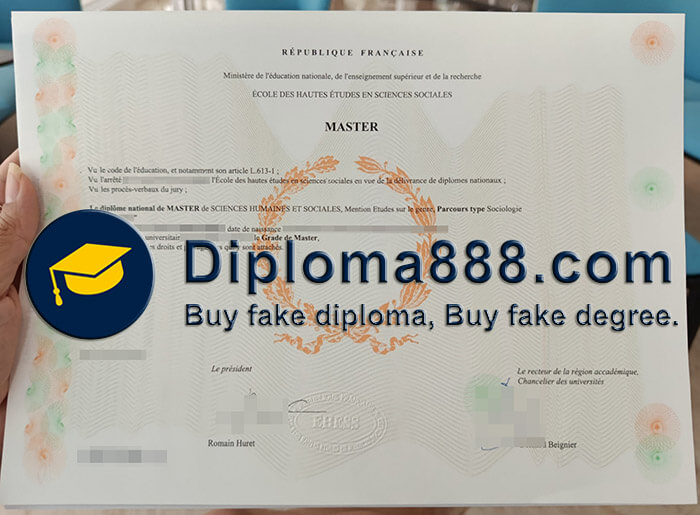
The École des hautes études en sciences sociales (EHESS), founded in 1975, is one of France’s most influential research institutions in the humanities and social sciences. #Copy École des hautes études en sciences sociales degree. As an elite institution within the French Grandes Écoles system, EHESS is renowned globally for its interdisciplinary research methods, cutting-edge theoretical exploration, and outstanding doctoral training model. Headquartered in the Boulevard des Hautes-de-France district of Paris’s 6th arrondissement, adjacent to the French National Centre for Scientific Research (CNRS), its numerous institutes are scattered throughout the heart of Paris’s intellectual landscape, forming a unique “open academic city.”
EHESS holds a leading position in contemporary social science theoretical innovation, boasting an academic legacy of 10 Nobel laureates and 28 members of the French Academy of Sciences. The Cost to buy a École des hautes études en sciences sociales diploma online. Purchase a Brevet de Technicien Supérieur diploma. Its unique “seminar system” completely breaks down traditional disciplinary boundaries, and it has established 42 joint laboratories with the French National Institute for Demographic Studies (INF) and the Institute for Contemporary History.
The Institute builds its knowledge system around six pillar areas:
History and Civilization: Global history and the history of mentality research pioneer new academic paradigms.
Anthropology and Society: Visual anthropology and medical anthropology break through disciplinary traditions.
Politics and Law: Political philosophy and legal sociology influence public policy. How long does it take to buy a EHESS degree certificate?
Economics and Management: Economic sociology and institutional economics reshape theoretical frameworks.
Art and Language: Literary theory and semiotic analysis lead critical thought.
Cognition and Digital: Digital humanities and cognitive science expand the frontiers.
EHESS implements an elite training model of “research as teaching,” admitting only 300 master’s students and 400 doctoral students annually, maintaining an optimal student-to-faculty ratio of 1:4. The Institute boasts the most comprehensive social science library, digital humanities laboratory, and field research archive in France. Its “Social Science Documentation Center,” co-built with the Collège de France, houses manuscripts by masters such as Foucault and Lévi-Strauss.