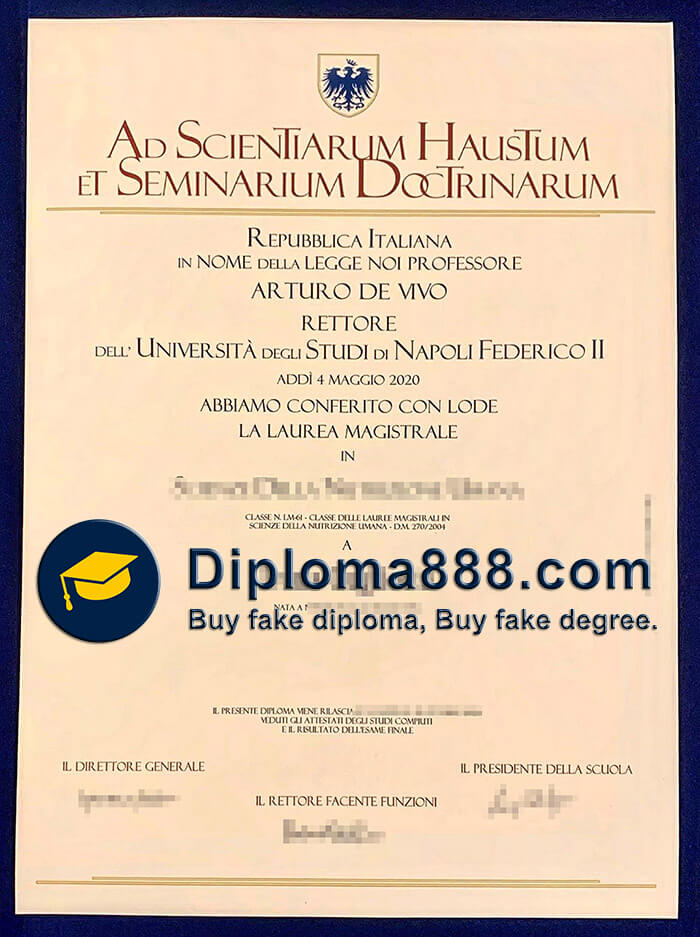
The University of Naples Federico II (Università degli Studi di Napoli Federico II), founded in 1224 by Holy Roman Emperor Frederick II, stands as Europe’s first state-founded, non-denominational public university. #Copy Università degli Studi di Napoli Federico II diploma. As the largest higher education institution in Southern Italy, the university currently enrolls approximately 80,000 students across 26 departments and employs a faculty and research staff exceeding 3,000. In the 2022 *U.S. News & World Report* Best Global Universities rankings, it was ranked 188th worldwide and 5th within Italy.
The academic scope of the University of Naples Federico II spans nearly every disciplinary field, including the humanities, social sciences, natural sciences, engineering, and medicine. Law and Literature represent the university’s historic flagship disciplines, boasting deep-rooted academic traditions in politics and jurisprudence; the renowned scholar of Greek language and culture, Marcello Gigante, was once a faculty member here. Where to make a Università degli Studi di Napoli Federico II degree? The School of Medicine and Surgery possesses a long and distinguished history; it operates a major university hospital and maintains extensive collaborative partnerships with institutions such as the Cardarelli Hospital—the largest in Southern Italy—and the National Cancer Institute, offering an English-taught undergraduate medical program open to international students.
The university demonstrates formidable strength in the field of engineering; its Master’s program in Mechanical Engineering boasts an employment rate exceeding 90% within one year of graduation, ranking among the top programs of its kind in Italy. Purchase a Università Vita Salute San Raffaele degree. In Computer Science, the university offers Master’s programs taught entirely in English, featuring specialized tracks in software engineering and cybersecurity. Furthermore, programs in Agriculture and Food Sciences, Economics and Management, Physics, Architecture, and Pharmacy all rank among the top in Italy.
The University of Naples Federico II is renowned for the diversity and flexibility of its curriculum. Replica University of Naples Federico II diploma certificate. The institution is structured around three primary academic pillars—the School of Science and Technology, the School of Medicine, and the School of Humanities and Social Sciences—which collectively oversee 26 departments. These departments offer 177 degree programs, including 21 programs taught entirely in English and 8 programs taught in a bilingual Italian-English format. The Medicine and Surgery program is a six-year integrated undergraduate-graduate course, offering distinct tracks for instruction in either English or Italian.
At the postgraduate level, the university offers 100 Master’s programs, 43 doctoral programs, and 16 specialized academies. The university has established an extensive network of exchange partnerships with higher education institutions worldwide and actively participates in various European and international exchange initiatives, such as the Erasmus+ program. Launched in recent years in collaboration with the Campania Regional Department of Education, the “Orizzonti” project offers high school students a three-day campus immersion experience, enabling them to explore laboratory practices and academic content across 13 distinct subject areas; to date, this initiative has served over 50,000 students.
In terms of campus life, the university’s 30 campuses are distributed throughout the city of Naples—ranging from the historic buildings of the Law School in the city center to the new Medical Campus atop Camaldoli Hill—collectively forming a true “university within a city.” The Central Library shares digital resources with the various departmental libraries and features dedicated multimedia learning spaces. Furthermore, the university hosts over 50 student organizations and 14 specialized museums, encompassing unique resources such as a botanical garden, a zoological museum, and a mineralogical museum.