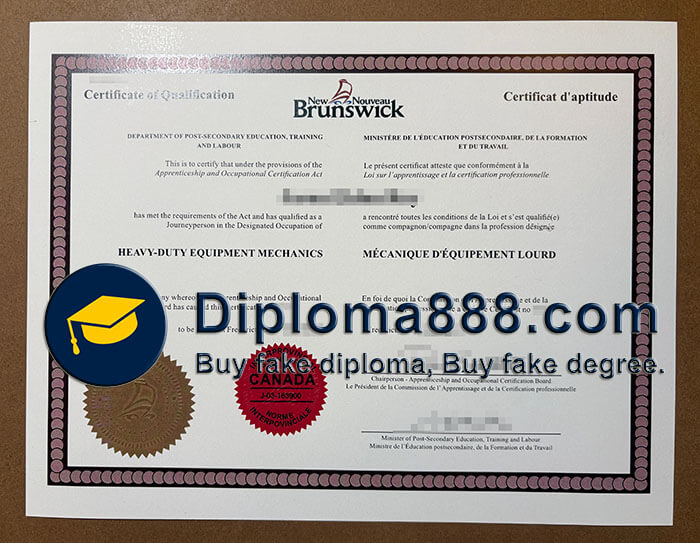
The New Brunswick Vocational Qualification Certificate is an official vocational qualification issued by the government of New Brunswick, Canada, under the Apprenticeships and Vocational Certification Act, and managed by Skilled Trades New Brunswick. #Copy New Brunswick Qualification Certificate. Buy a New Brunswick Machinist certificate. This certificate is not a traditional university degree, but rather an authoritative professional credential proving that the holder has met the professional standards for a specific technical industry, serving as a legal passport to the labor market in New Brunswick and across Canada.
The New Brunswick Vocational Qualification Certificate covers 71 designated industries, 50 of which are Red Seal industries, allowing holders to practice throughout Canada. WhatsApp: Please contact us. There are three main pathways to obtaining the certificate:
Apprenticeship Pathway: This is the mainstream path, accounting for approximately 80% of applications. Where to make a New Brunswick Qualification Certificate? Apprentices sign an agreement with an employer to complete 2 to 5 years of paid on-the-job training, supplemented by 20% classroom technical training, culminating in a diploma and qualification certificate upon passing a final examination. Industry Certification: Individuals with sufficient practical experience can apply to directly take the certification exam. Purchase a Alberta Journeyman certificate.
The core advantage of this certificate system lies in its nationwide applicability and industry recognition. Apply for New Brunswick Heavy-Duty Equipment Mechanics certificate online. The certificate, endorsed with the Red Seal, means that certificate holders can work in designated industries in any province of Canada without needing to undergo recertification. New Brunswick currently has 50 Red Seal industries, covering core areas such as construction electricians, carpenters, welders, heavy equipment technicians, and industrial mechanics.
The demand for skilled workers remains strong in New Brunswick and throughout Canada. Approximately 80% of the training is paid on-the-job training, and 20% is classroom learning. This model ensures graduates possess the practical skills employers need immediately. Certified skilled workers can secure stable employment and high salaries in key industries such as construction, manufacturing, energy, and transportation, with clear career paths—from instructors and site supervisors to self-employment—playing an indispensable core role in the Canadian economy.