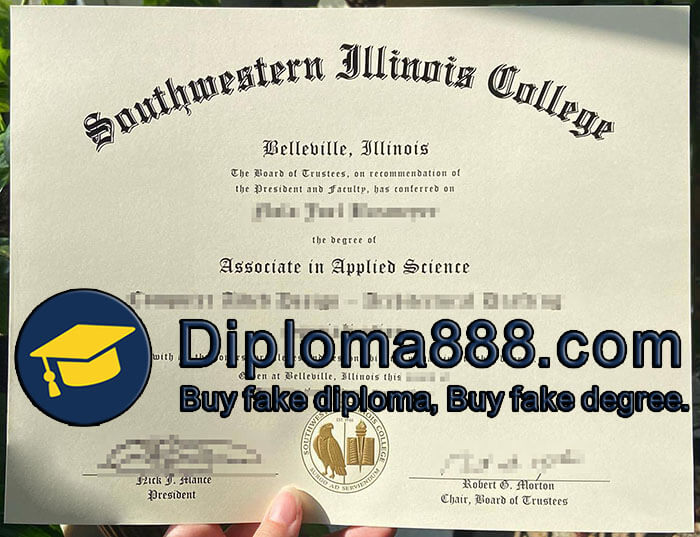
Founded in 1946, SWIC has its main campus in Belleville, Illinois, with additional locations in Granite City, Red Bud, and East St. Louis. #Copy Southwestern Illinois College diploma. As a two-year public community college, it does not offer on-campus housing, and the student body consists primarily of commuters. The college has an enrollment of approximately 8,492 students, 5,551 of whom are part-time; 30% of the student population is over the age of 25, reflecting the institution’s focus on serving adult learners and working professionals.
Academic Programs and Key Fields
SWIC’s academic offerings center on career-oriented certificate and associate degree programs, alongside a comprehensive curriculum designed for transfer to four-year universities. Where to make a Southwestern Illinois College degree? Nursing and health sciences are the college’s strongest fields in terms of employment outcomes. Graduates of the welding technology certificate program, for instance, see a 67% employment rate within six months of completion, making it one of the highest-paying programs at the college.
Curriculum and Learning Pathways
A core strength of SWIC lies in its dual focus on university transfer pathways and vocational training. Order a Quincy University degree. The college maintains transfer agreements with institutions such as Southern Illinois University Edwardsville (SIUE), the University of Illinois Urbana-Champaign, and several universities in Missouri. Its Associate of Arts (AA) and Associate of Science (AS) degrees are designed for seamless transfer, covering fields such as engineering, business, and health sciences. Furthermore, the Illinois Articulation Initiative (IAI) ensures that general education credits are transferable among public universities throughout the state.
Regarding admissions and costs, tuition for in-district students is approximately $122 per credit hour (as of 2024)—a rate significantly lower than that of four-year universities. Replica SWIC diploma certificate. Students have access to various forms of financial aid, including Pell Grants, the Illinois Monetary Award Program (MAP) grant, scholarships through the SWIC Foundation, and work-study opportunities. To accommodate the needs of working students, the college offers flexible learning formats, including evening, online, and hybrid courses.