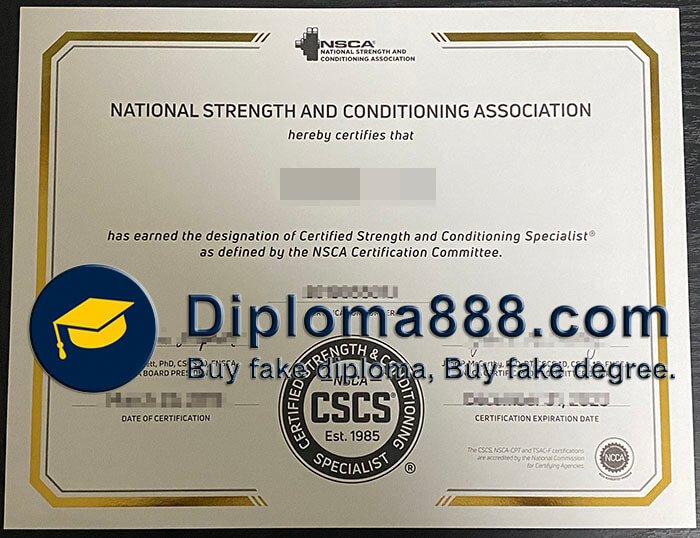
The Certified Strength and Conditioning Professional (CSCS) is a top-tier global professional certification awarded by the National Strength and Conditioning Association (NSCA), and is one of the most authoritative qualifications in the field of strength and conditioning. #Copy CSCS certificate online. Established in 1993, it was the first strength and conditioning coach certification in the United States to be accredited by the National Committee on Certification Agencies (NCCA), and is designed specifically for professionals dedicated to improving athletes’ performance through scientific methods.
Unlike a university degree, the CSCS is a professional competence certification, demonstrating the holder’s professional ability to design and implement safe and effective training programs using knowledge of sports science. Purchase a Society of Actuaries certificate in USA. Obtaining CSCS certification requires meeting stringent qualification requirements and passing two main exams. Candidates must hold a bachelor’s degree (or be a senior in college) and have valid CPR/AED certification.
Reclaim Your Success: Get a NSCA certificate Copy Online
From January 1, 2030, US candidates will also need to graduate with a relevant degree from a CASCE-accredited program. Where to make a Certified Strength and Conditioning Professional certificate? The exam consists of two modules: Scientific Foundations and Practical Application. The pass rate is approximately 41%, with the practical application section having a pass rate of only 44%, highlighting its high difficulty and prestige. Certification requires renewal every three years through Continuing Education Credits (CEU).
The core advantage of CSCS certification lies in its scientific rigor and global industry recognition. The exam covers a comprehensive range of knowledge, from exercise physiology and biomechanics to periodization, nutritional strategies, and sports psychology. CSCS emphasizes “learning by doing”—certifiers must be able to design personalized training programs based on an athlete’s age, gender, training level, and sport characteristics, while also considering injury prevention and recovery management.